Every day, millions of people rely on public transit to move through their lives: to get to work, to study, to meet friends and to remain independent. Yet the way they interact with mobility systems is far from uniform. People differ in physical abilities, sensory perception, language skills, digital confidence and situational needs.
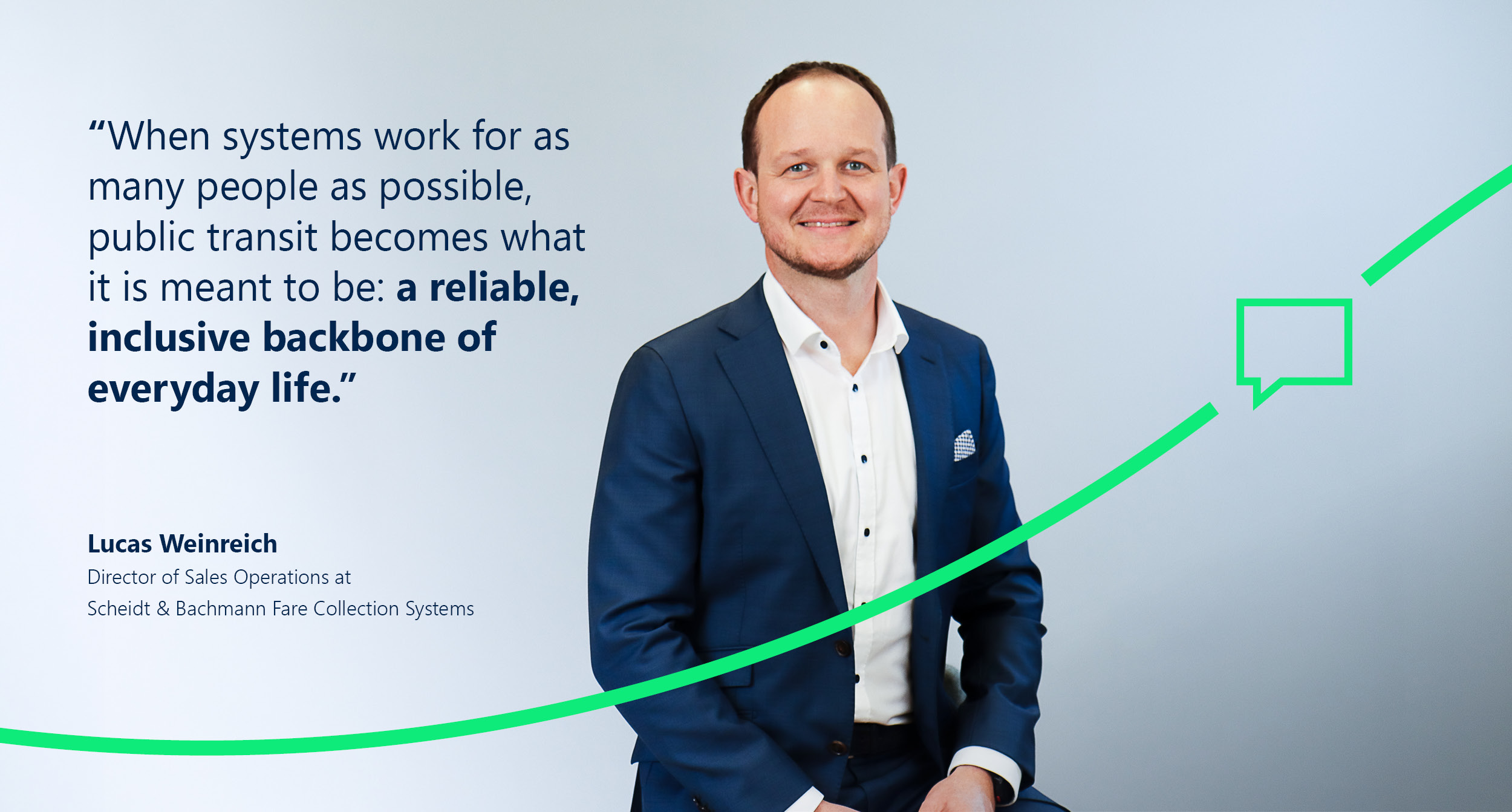
On the occasion of Global Accessibility Awareness Day (GAAD), Lucas Weinreich, Director of Sales Operations at Scheidt & Bachmann Fare Collection Systems, shares his perspective on what this diversity means for the way technology in public transit is designed, and how this perspective shapes our approach to devices, software and customer interfaces.
At Scheidt & Bachmann Fare Collection Systems, accessibility is therefore not treated as an afterthought or a compliance exercise. It is a fundamental part of how we think about devices, software and customer interfaces from the very first design decision.
Accessibility starts where interaction begins
For passengers, accessibility is experienced at the point of interaction: at the ticket machine, at the validator, at the gate or on the screen.
Our ticketing devices and customer interfaces are designed for use in complex, real-world environments, often under time pressure, in unfamiliar surroundings or in stressful situations. That is precisely why clarity, consistency and intuitive interaction are essential.
Large, readable displays, clear visual hierarchies, tactile and acoustic feedback, and logical navigation are not simply “nice to have”. They reduce barriers for people with impairments and, at the same time, make systems easier to use for everyone.
The newly developed ticket vending machine FareGo ST|32, for example, is conceived as an all in one kiosk that goes beyond ticketing. It serves as an information point and enables direct, video based interaction with remote customer service.
Devices such as the FareGo PG|50 fare gate address accessibility at other interaction points by enabling intuitive passenger flow. Clear visual guidance, wide aisle variants and supportive audio and visual features help accommodate passengers travelling with children, luggage, strollers or mobility aids.
Both are examples from our holistic fare collection portfolio, reflecting an approach in which accessibility is embedded across the entire passenger journey and creates reliable points of contact for a wide range of passengers, regardless of individual limitations or experience.
Inclusive design benefits all passengers
Accessibility does not only support people with permanent disabilities.
It also supports people in everyday situations:
- a parent travelling with a stroller
- a traveller unfamiliar with the local language
- a passenger using a device in bright sunlight
- someone with an injury or limited mobility
Designing for accessibility means designing for reality. And reality is diverse.
In addition, a well‑designed and comprehensive fare collection system plays an important role in supporting inclusion. By offering different access channels and payment options, it can accommodate a wide range of needs and preferences, regardless of whether passengers have a bank account, use a smartphone, or choose to pay in cash, use contactless payment or remain anonymous.
Our software solutions and user interfaces are therefore designed with clear user guidance, consistent interaction logic and adaptability across different devices and use cases. Inclusive design supports usability, improves operational efficiency and contributes to consistent system acceptance.
Reliability and accessibility belong together
Accessible systems must also be reliable.
A user-friendly interface loses value if it fails under operational pressure. At the same time, a technically robust system that is difficult to use does not fulfil its purpose.
Our hardware and software platforms are developed with both aspects in mind: stable operation for transit authorities and operators, and intuitive, accessible access for passengers. Reliability creates confidence. Accessibility ensures inclusion. Only together do they deliver a positive mobility experience.
Accessibility as a measure of quality
Public transit is a public service. And accessibility is one of its clearest indicators of quality.
On GAAD, awareness is the first step. But it should not stop there. Digital accessibility must be embedded in development processes, design standards and decision-making. Not because regulations require it, but because good design demands it.
At Scheidt & Bachmann, we see accessibility as part of professional responsibility. When systems work for as many people as possible, public transit becomes what it is meant to be: a reliable, inclusive backbone of everyday life.
Lucas Weinreich
Director of Sales Operations at Scheidt & Bachmann Fare Collection Systems