This website uses cookies

This website uses cookies to ensure the functionality of the website. In addition, with your consent, we can use cookies to collect information on the use of the website in order to constantly improve the website. By clicking on the “Only allow essential cookies” button, you reject the use of cookies other than essential cookies. By ticking the “Statistics” and “Marketing” boxes and clicking the “Allow selection” button, you consent to the use of other cookies. All essential, marketing and statistics cookies are accepted via the “Accept all cookies” button. You can obtain differentiated information on the individual cookies in the data protection information. You can revoke your consent at any time by clicking on the “Cookie settings” button at the bottom left.


Essential cookies enable basic functions and are necessary for the website to function properly.
Statistics cookies collect information anonymously. This information helps us to understand how our visitors use our website.
Marketing cookies are used by third parties or publishers to display personalized advertisements. They do this by tracking visitors across websites.


Protecting Fare Revenue. Strengthening Trust in Public Transport

|   Fare-Collection-Systems

Fare evasion is more than a loss of revenue – it can undermine fairness, passenger confidence and the long-term sustainability of public transport.

While fare evasion can happen for many reasons, the financial impact is often driven by a smaller group of chronic offenders who deliberately exploit weaknesses in existing systems.

In cities such as Melbourne, New York, London and Toronto, the resulting losses demonstrate why revenue protection has become a strategic priority for transport operators.

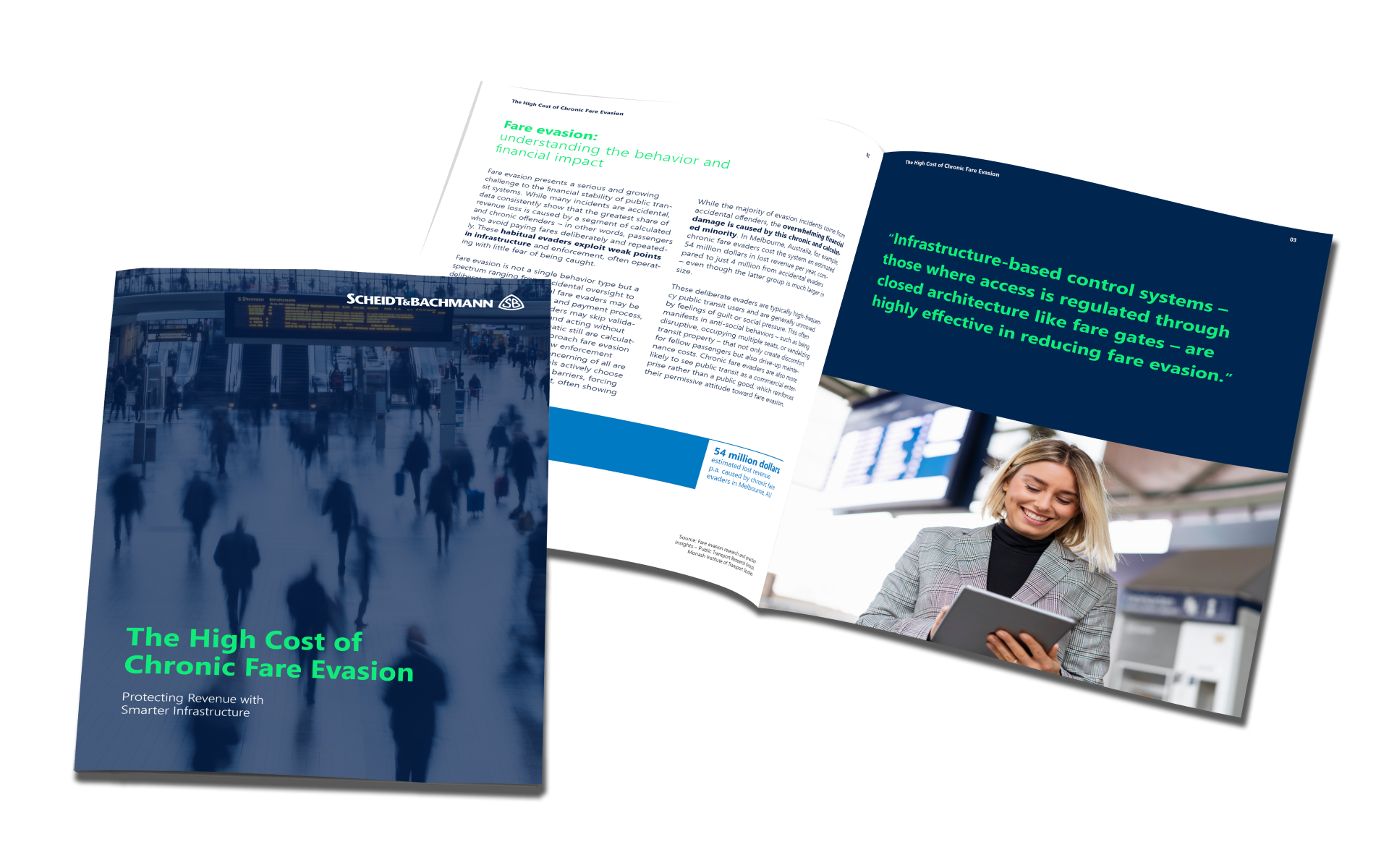
Our whitepaper, “The High Cost of Chronic Fare Evasion,” explores how transport agencies can respond with a combination of smarter infrastructure, inclusive design and complementary measures.


Inside, you’ll discover:

- Why chronic fare evasion creates a disproportionate financial impact
- How closed fare collection systems can strengthen revenue protection
- Why modern fare gates need to balance security, accessibility and passenger flow

Protecting fare revenue is not just about preventing losses. It is about safeguarding trust in public transport and ensuring that honest passengers are not disadvantaged.


Click here to download the white paper “The High Cost of Chronic Fare Evasion” and learn how smarter infrastructure can help build safer, more inclusive, and sustainable transportation networks.




Frank Dohmen

Human Resources


Yvonne Kuzmanovic

Human Resources
 

jobs@scheidt-bachmann.de

Scheidt & Bachmann GmbH
Breite Str. 132
41238 Mönchengladbach

Find a Career

Contact us

Fields marked with * are required